The Bunnings Workshop community can help with your home improvement projects.
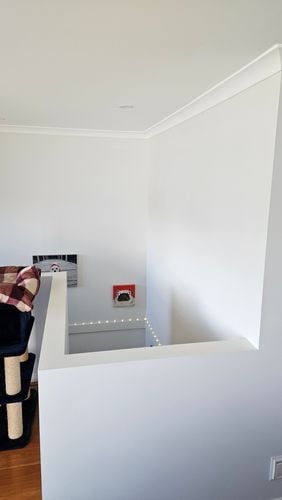
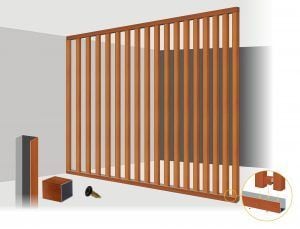
Hi team. I'm looking to build a partition wall similar to the below above my staircase and looking for advise. Its an L shaped shaircase with a 1/2 height wall around it which I'm wanting to extend to the ceiling
I was looking at using the Claymark 64x19m DAR Pine Premium and staining it when it done.
My questions are:
- what screws would be best to join it all together?
- what plasterboard anchors would you recommend to secure it to the ceiling?
- how would you suggest i best secure it to the top of the 1/2 wall? I have to drill a hole to confirm but i believe theres a metal frame along the top of the wall.
- anything else i should consider or be mindful of?
Thanks in advance
Hello @atrodd
Welcome to the Bunnings Workshop community. It's sensational to have you join us, and thanks for sharing your question about building partition wall.
We've had a few queries regarding this question. I suggest having a look at these discussions:
However, to answer your questions, I suggest using the Zenith 8G x 60mm Countersunk Rib Head Chipboard Screws - 50 Pack to screw the timber together on the condition that you are using 64 x 19mm 2.4m DAR Pine Premium for the top and bottom section of the frame. If you can't locate a ceiling stud to anchor onto, I suggest using Ramset M6 x 13mm Hollow Wall Anchor - 20 Pack to anchor the top of the structure to the ceiling. For extra support I suggest using Selleys 350g Heavy Duty Liquid Nails where the partition meets the ceiling and the staircase half wall.
To secure the half wall properly, I suggest drilling into the top section. It will be necessary for you to investigate to find out what material was used on top section of the half wall and see if it can be anchored onto.
Let me call on our experienced members @Dave-1, @Nailbag and @AlanM52 for their recommendations.
If you need further assistance, please let us know.
Eric
Hi @atrodd,
Although the partitions are not loadbearing they need to withstand the forces of an adult person stumbling/tripping or even loosing their balance and falling backwards through the partition and going over the wall. I propose the top should be fixed to the ceiling joists and if needed access the roof to install more joists.
Cheers
Good morning @atrodd
Both @EricL and @AlanM52 have put forward the suggestions I was thinking of ![]()
The only thing I can add is I have a small amount of heitation over the size of the timber you are using. I know that you will have multiple lengths but the 65mm width is what my concern is flagging. Mainly as these will have to hold back an adult if the stumble and fall into it.
Dave
Thanks for the advise and suggestions. I'm not really concerned about someone falling through it as the half wall is high enough to prevent anyone going over the edge. It just needs to be secure enough to not buckle if someone were to push it or potentially lean against it briefly.
I'm hoping securing it to the top of the half wall will do the majority of the work. The half wall is pretty solid on the top so i assume there is a frame but will have to drill a hole to confirm. But hopefully there is a joist in the ceiling i can also secure it to. Unfortuantely i have no way of accessing the roof to install additional joists if needed so wall anchors might have to suffice.
What would be the best order of operations for this project? I was thinking, construct the outer frame first, then add the individual vertical posts, secure it to the half wall and ceiling and finally strain it. Ill be constructing two sections to make the L shape.
Afternoon @atrodd
First up I would measure multiple points from the half high wall to the ceiling as ceilins are not always straight.
Then I would construct the whole one side of the L panel first on the floor and lift and tilt into place.
There should be hopefully beams you have in the ciling that cross your L section, Maybe use a stud finder to see? I am not really keen on wall anchors for plaster to secure the top. If you go that route maybe Butterfly type bolts is what I would use. (The ones that poke through and then the ends splay out. Ramset 3 / 16" x 75mm Plasterboard Spring Toggle Anchor - 10 Pack )
Dave
Hi @atrodd,
Like @Dave-1 mentioned, you can't always trust that the ceiling will be perfectly flat, so I'd be marking the ceiling where the top plate will be installed, then using a straight edge like a long spirit level to check for straightness. Minor deviations can be covered with No More Gaps, but wider stuff would require you to either cut the verticals to different lengths, so the top plate is slightly curved or scribe and plane the top plate to suit.
While you are working on the ceiling, I'd also be using a stud finder to check for the location of studs and mark their locations on your top plate so it can be predrilled before lifting into place. Similar to Dave, I wouldn't be too keen on just using plasterboard anchors, so do your best to locate some framing.
If you find the ceiling is nice and straight, which hopefully it is, you should be ok to measure the height at the locations of the outermost verticals, then screw them to the top and bottom plate and then simply fill in the gaps between measuring and installing as you go. If the two outermost verticals are the same height, then the verticals in between will be the same, but if they are different, you will need to measure as you go.
Once the frame is built, mark out your fixing locations and predrill holes for them. You don't want to be messing around drilling holes while you are lifting the frame into place and perched on a ladder, so anything that can be done on the ground should be. Make sure you have a helper and preferably two at this stage.
The main thing I would be focusing on is getting a solid connection to the ceiling. You can be pretty confident with your attachment to the half wall, as there will be a framing member along its full length, but the ceiling is a different matter, so take the time to locate as many studs as possible and use plasterboard anchors as sparingly as possible. If adding additional framing to the ceiling is not possible, personally, I would be inclined to check for ceiling framing first, then adjust my design to suit it. If that means adjusting the spacing of the verticals so that a screw can go up into the ceiling where the framing sits, then I would be doing that.
Let me know what you think and if you have further questions, please don't hesitate to ask.
Jacob
Thanks for the advice. I've measured from the ceiling to the top of the half wall in several spots and it seems to be mostly pretty level. One section is dead even, the other section has about a 6-7mm difference between the end points.
I've also quicky run a stud finder across the ceiling and there seems to be some studs where I need them so hopefully I'll have alteast a couple of anchor points on the ceiling.
I'm hoping to get started on the project this weekend so I'll see how I go. I'm thinking I'll put together the outer frame first and them temporarily put it in place and mark exactly where it meets with the ceiling and from there locate and pre-drill the holes for the studs. Based on that I can determine the exact spacing for the inner verticals before cutting and attaching them. Hopefully it all goes well.
Ok so i managed to find one stud in the ceiling for each section of the partition wall. Was hoping to find more but it will have to do. Will chuck in a couple of the spring toggle anchors for extra support. What screws should i use to attach the frame to the studs on both the top of the half wall and the ceiling. Are the chipboard screws recommended above to construct the partition wall adequate?
Hi @atrodd,
If the framing is timber, they would be fine, but if it is steel, they wouldn't be because the thread is far too open. With steel framing, you need to use a fine thread screw because, as the thread pulls through, it essentially clamps around the steel, holding everything in place.
I'm not entirely sure why, but our website isn't showing me the full selection of screws right now for me to link you to a specific one. For steel framing, you'll want to use a 50mm fine thread plasterboard screw. I am sure they are available in store, but I can't find a link to send to you.
If you head in store and speak with the Builders team, I am sure they would be able to point you in the right direction.
Let me know if you have any further questions.
Jacob
Workshop is a friendly place to learn, get ideas and find inspiration for your home improvement projects
We would love to help with your project.
Join the Bunnings Workshop community today to ask questions and get advice.