
The Bunnings Workshop community can help with your home improvement projects.
- Bunnings Workshop
- >
- Discussion
- >
- Whole of House
- >
- How to fix indoor timber stairs movement...
How to fix indoor timber stairs movement sound?
- Subscribe to RSS Feed
- Mark Topic as New
- Mark Topic as Read
- Float this Topic for Current User
- Bookmark
- Subscribe
- Mute
- Printer Friendly Page
Share


- Mark as New
- Bookmark
- Subscribe
- Mute
- Subscribe to RSS Feed
- Highlight
- Report Inappropriate Content
How to fix indoor timber stairs movement sound?
Good afternoon
I purchased a new house 2 years ago and over time the stairs have begun to make a decent amount of movement noise. The noise occurs at pretty much all levels on the stairs. It's pretty consistent and I'm describe it more as creaky than squeaky.
The house is a 2-storey steel frame but the stairs are wooden. In the landing area above the stairs on the second storey, walking around can also cause the same movement sounds on the stairs (plus some metal pinging from the frame). After moving about 2m away from the top of the stairs, walking causes far less movement sounds on the stairs.
I've attached some pictures and am looking for some guidance as to what the cause is and what I can DIY to minimise noise. I do have access to under the stairs if that helps.
Also wondering if anyone can recommend some alternatives to the gripper rods...
Thanks in advance


- Labels:
-
Flooring
-
Repairing
-
Tools and Materials


- Mark as New
- Bookmark
- Subscribe
- Mute
- Subscribe to RSS Feed
- Highlight
- Report Inappropriate Content
Re: Indoor timber stairs movement sounds - what to do to minimise noise
Hello @jcke
Welcome to the Bunnings Workshop community. It's sensational to have you join us, and thanks for sharing your question about your timber stairs.
From your description, the problem is very typical of timber stairs installed into a steel-frame house. What you’re hearing is mostly timber-on-timber friction, with a little bit of resonance transferred into the steel frame. The creaking occurs when stair treads, risers, and stringers move ever so slightly against each other. Over two years of seasonal expansion and contraction, fixings can loosen, and gaps can open just enough to allow consistent movement noises. The fact that you also hear it when walking on the upstairs landing suggests that the load from the upper floor is transferring into the stair stringers and fixings, making them flex and rub against each other.
The main causes are usually a combination of minor shrinkage in the timber, nails or screws that have loosened, and small gaps between treads and risers where timber moves and rubs. The metal “pinging” you mention is almost certainly the steel frame expanding or slightly shifting under load, which can amplify the sound.
Since you have access under the stairs, you’re in a good position to try some DIY fixes. One approach is to reinforce the junctions where the treads meet the risers and the stringers. Driving in additional screws through the back of the stringer into the tread can lock things more tightly. For areas that still move, you can inject a good quality woodworking adhesive or construction adhesive (such as Selleys Liquid Nails or Sikaflex polyurethane adhesive) into the joints before re-screwing. The adhesive helps bind surfaces and reduce friction that causes creaking. Where screws can’t be added neatly, thin timber wedges coated in glue can be tapped into gaps to tighten the fit between tread and riser.
For the upstairs landing area transferring noise into the stairs, it may help to check whether the floor joists or supports are properly secured to the stairhead and the steel frame. Sometimes additional fixings or packing shims at these points reduce flex and vibration. If you’re comfortable, you can also add timber cleats or blocking underneath the stair stringers to stiffen them, which often cuts down movement noise dramatically.
As for gripper rods, if you’re planning to lay carpet on the stairs, there are alternatives. Some people prefer using stair nosing profiles with integrated carpet clamps such as Roberts 3.6m Silver Single Over Carpet Square Stairnose or even heavy-duty carpet adhesive systems rather than rods.
Let me call on our experienced members @Dave-1 and @Nailbag for their recommendations.
If you need further assistance, please let us know.
Eric


- Mark as New
- Bookmark
- Subscribe
- Mute
- Subscribe to RSS Feed
- Highlight
- Report Inappropriate Content
Re: Indoor timber stairs movement sounds - what to do to minimise noise
Good Evening @jcke
I would also like to offer a warm welcome to the Bunnings community pages  Definently a good place to start with trying to sort the creaking sound out.
I havnt had a lot of experience with creaking steps, and must admit to following @EricL 's information and nodding my head. Its the lines of what I would do without knowing the reason why the creaks were happening. I like the idea of adding extra cleats or blocking to the underside plus glue to help with that rubbing that causes the creaks as a solution.
Maybe start off with the lower section first. Then assess it for a week or two and see if that section is quieter before going all in?
Dave

- Mark as New
- Bookmark
- Subscribe
- Mute
- Subscribe to RSS Feed
- Highlight
- Report Inappropriate Content
Re: Indoor timber stairs movement sounds - what to do to minimise noise

- Mark as New
- Bookmark
- Subscribe
- Mute
- Subscribe to RSS Feed
- Highlight
- Report Inappropriate Content
Re: Indoor timber stairs movement sounds - what to do to minimise noise
Hi @jcke
The first thing I would be checking is the wedges. If you look at the sides of the stairs, there are wedges under each tread and possibly behind each upright. Make sure they are all still secure and tight. After that the advice already given is what I would have recommended however I would have recommended a good wood glue and not liquid nails but hat is just my preference.
- Mark as New
- Bookmark
- Subscribe
- Mute
- Subscribe to RSS Feed
- Highlight
- Report Inappropriate Content
Re: Indoor timber stairs movement sounds - what to do to minimise noise
Thanks all and Eric for your thorough response.
I'm certainly keen to give this a go - just seeking some clarity about specifically where through the stringer you'd recommend the screws?
Red arrow is below is through what I would call the stringer itself, whereas yellow is not in via the stringer but through the vertical timber wedge.
Green is for the adhesive.


- Mark as New
- Bookmark
- Subscribe
- Mute
- Subscribe to RSS Feed
- Highlight
- Report Inappropriate Content
Re: Indoor timber stairs movement sounds - what to do to minimise noise
Hi @jcke,
I wouldn't drive screws through the wedges, but I would give them a few taps with a hammer before adding any screws. This will make sure the treads and risers are hard up against the notches in the stringers.
You can see where nails have been used. I would just drive screws in between the nails. 4 - 5 across each tread should do the trick.
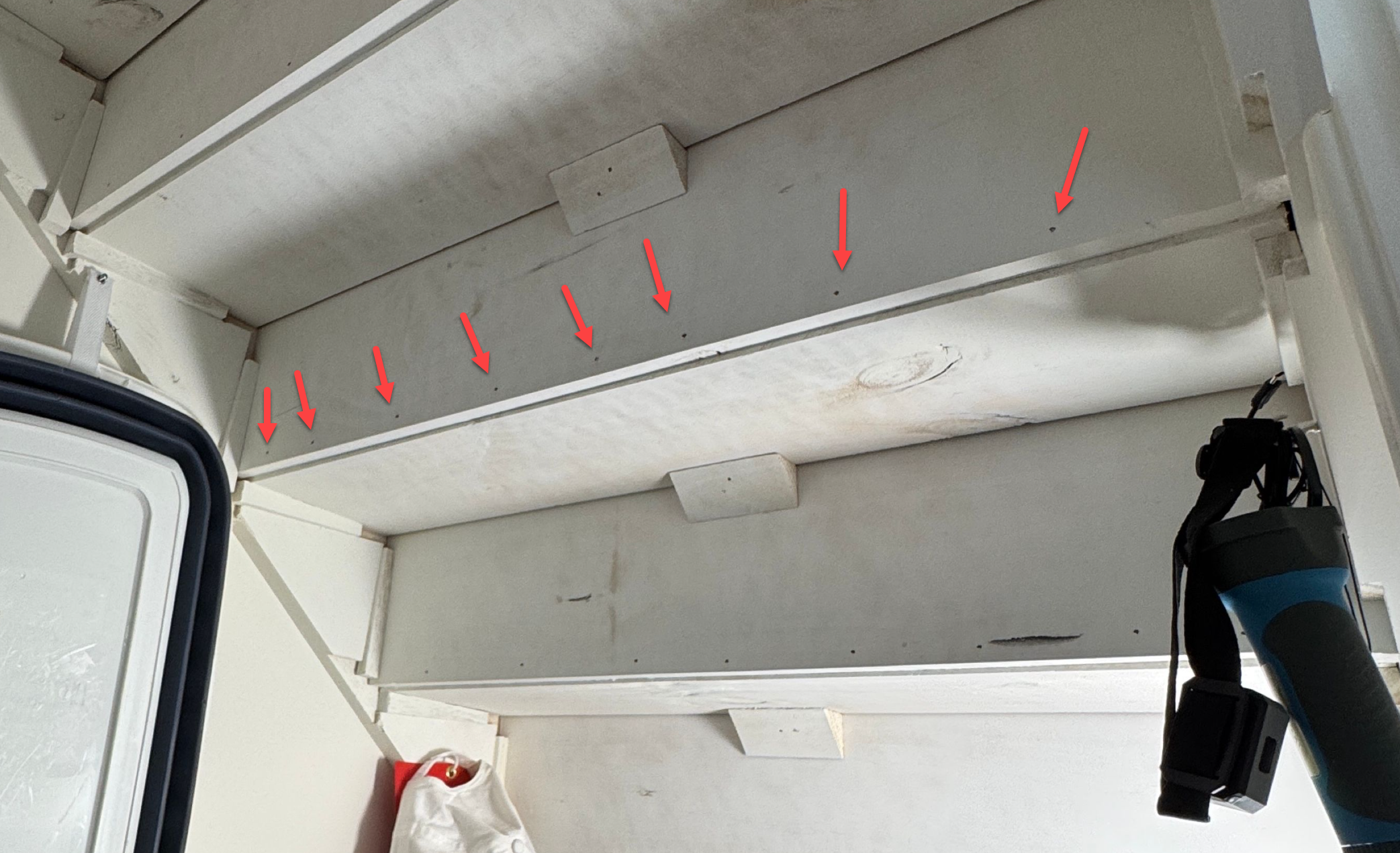
Let me know what you think.
Jacob
- Mark as New
- Bookmark
- Subscribe
- Mute
- Subscribe to RSS Feed
- Highlight
- Report Inappropriate Content
Re: Indoor timber stairs movement sounds - what to do to minimise noise
Oh that is so much easier than what I was thinking. Totally doable. Is there a particular size of screw ideal for this kind of work, or it doesn't really matter?
- Mark as New
- Bookmark
- Subscribe
- Mute
- Subscribe to RSS Feed
- Highlight
- Report Inappropriate Content
Re: Indoor timber stairs movement sounds - what to do to minimise noise
Hi @jcke,
The squeaking is usually due to movement, and nails tend to allow a little bit of flex, whereas screws don't tend to unless there is an issue with them. I can't guarantee this is the source of the movement, but it is certainly a good starting place.
I'd just use a 50mm timber screw, such as these 10G x 50mm Countersunk Head Timber Screws.
Just make sure you put a pilot hole that is deep enough and a wide enough diameter for your screws. For 10g screws, use a 3.5mm drill bit.
Let me know how it goes, happy to help further if required.
Jacob

Why join the Bunnings Workshop community?
Workshop is a friendly place to learn, get ideas and find inspiration for your home improvement projects
You might also like








We would love to help with your project.
Join the Bunnings Workshop community today to ask questions and get advice.