
The Bunnings Workshop community can help with your home improvement projects.
- Bunnings Workshop
- >
- Discussion
- >
- Whole of House
- >
- Re: What is the best strong wood glow ?
What is the best strong wood glue?
- Subscribe to RSS Feed
- Mark Topic as New
- Mark Topic as Read
- Float this Topic for Current User
- Bookmark
- Subscribe
- Mute
- Printer Friendly Page
Share


- Mark as New
- Bookmark
- Subscribe
- Mute
- Subscribe to RSS Feed
- Highlight
- Report Inappropriate Content
What is the best strong wood glue?
What is the best strong wood glow ?


- Mark as New
- Bookmark
- Subscribe
- Mute
- Subscribe to RSS Feed
- Highlight
- Report Inappropriate Content
Re: What is the best strong wood glow ?
Hello @Hosam
Welcome to the Bunnings Workshop community. It's sensational to have you join us, and thanks for sharing your question about wood glue.
Can you please give us a little bit more information about your project? Are you building timber furniture or are you trying to repair something on your timber furniture? Personally, I have used a few varieties of wood glue, I'm currently using Gorilla 532ml Ultimate Wood Glue which gives an extended working time of 15minutes, it's 100 percent waterproof. It provides an excellent bond and is very reliable.
However, sometimes wood glue is not enough, and mechanical fixings will need to be added in combination with the glue. This is why its important for us to find out what you are working on, because wood glue will only provide so much holding power extra support might need to be added to hold your repair or project in place.
Let me call on our experienced members @Dave-1, @Nailbag, @diy_hausdesigns and @JoeAzza for their recommendations.
If you need further assistance, please let us know.
Eric


- Mark as New
- Bookmark
- Subscribe
- Mute
- Subscribe to RSS Feed
- Highlight
- Report Inappropriate Content
Re: What is the best strong wood glow ?
Good Afternoon @Hosam
I am wondering what types of timber you are trying to join? If you can supply a couple of photos showing the different types of timber and the overall type of join angle/support we may be able to narrow down the best glues.
As a general note I have had a huge success using liquid nails, but thats a general description of timber joined to say plaster, timber to timber that wont have added stresses is another good use I have done. If the timber pieces that you are joining have pressure to pull them apart then I would go down the route of liquid nails and some screws or bolts to have a mechanical connection as well.
Will wait for some pics 
Dave
- Mark as New
- Bookmark
- Subscribe
- Mute
- Subscribe to RSS Feed
- Highlight
- Report Inappropriate Content
Re: What is the best strong wood glow ?


- Mark as New
- Bookmark
- Subscribe
- Mute
- Subscribe to RSS Feed
- Highlight
- Report Inappropriate Content
Re: What is the best strong wood glue?
Hi @Hosam
Decades ago a woodworker taught me that basic wood glue is white and the good stuff is a light creamy colour. All the top brands like SIKA, Selleys and Gorilla make excellent cream coloured PVA glues. The Gorilla @EricL linked is the fastest to set in around 15min the other two say 24hrs, but thats to full strength.
I have been using the SIKA one for many years and found it to be excellent and can usually unclamp the small jobs in around 30min. I gave the Gorilla a go when it ran out. I can't pick the difference in performance. But I can't stand the dispenser tip on the Gorilla. It doesn't allow for a fine thin bead of glue and it clogs up very easily and hard to clear. So I decanted it into the SIKA bottle.
Nailbag

- Mark as New
- Bookmark
- Subscribe
- Mute
- Subscribe to RSS Feed
- Highlight
- Report Inappropriate Content
Re: What is the best strong wood glow ?
Hi @Hosam
If this the photo of the damaged wall that you want to use wood glue. I think you are going to need more than wood glue.
First thing, what material is the wall made of, is it Masonite or cement sheeting?
If it’s cement sheet and has been installed many years ago, it could be asbestos fibre board. @EricL Could please advise on what to do if it is asbestos board.
If it is Masonite board, then I suggest to cut it the panel and replace it with a new piece.
- Mark as New
- Bookmark
- Subscribe
- Mute
- Subscribe to RSS Feed
- Highlight
- Report Inappropriate Content
Re: What is the best strong wood glow ?
Hello @Hosam
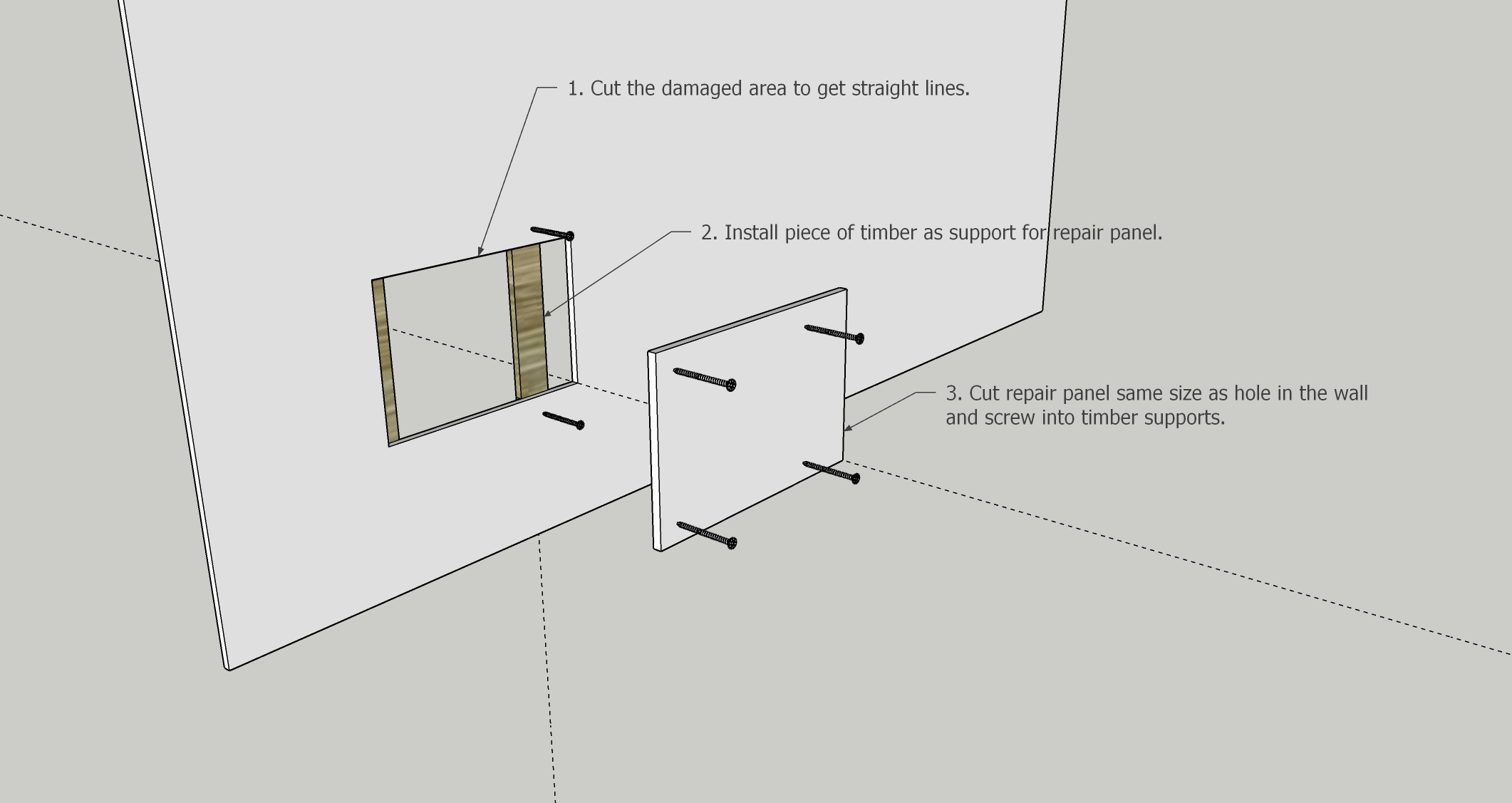
Thank you for sharing that photo of your wall. It might be possible to glue the broken parts together, but it will not be as flat as it was before. It would be better to cut the broken section out and patch it with a repair piece. It appears to be made of Masonite or an MDF panel, it will be necessary to take piece off just to be sure. Once you have identified the wood, I propose getting a similar panel and using a hand saw to cut the damaged section off. Cutting it out in a rectangular shape would be easier as you can cut the repair piece in the same shape.
I propose placing a support timber brace in the cut section of the wall so that you have a point to mount the repair patch on. I've placed an image below to give you an idea of how it can be done. If the patch is cut with precision the gap between the wall and the repair piece should be minimal and can be filled with Parfix 500g Ready To Use Multipurpose Filler - 500g. Allow the filler to cure and sand it down flat. The wall can then be primed and painted.
If you need further assistance, please let us know.
Eric
- Mark as New
- Bookmark
- Subscribe
- Mute
- Subscribe to RSS Feed
- Highlight
- Report Inappropriate Content
Re: What is the best strong wood glow ?
Thank you @Hosam
That "wood" looks like masonite and if it is (You could always take a small piece into Bunnings to confirm) then the easiest would be to replace the whole section.
masonite will show you a range of sizes and thicknesses.
I would look for the timber trim edges that will be around the section of masonite, you can then measure the area to see if you can replace with one sheet. Removing the timber trim gently with a claw hammer (keep the trim as you will reuse it) Once the old section has been pulled off or cut to a size you are happy with then install the new piece , replace the trim and paint.
Dave

- Mark as New
- Bookmark
- Subscribe
- Mute
- Subscribe to RSS Feed
- Highlight
- Report Inappropriate Content
Re: What is the best strong wood glue?
Just a quick safety reminder @Hosam, for those working with older materials like Masonite, MDF, or cement sheeting, especially if they were installed before the 1990s. There’s a chance these materials could contain asbestos, which is a serious health hazard if disturbed. If you suspect that the material might be asbestos, do not disturb it. It’s best to have it professionally tested to be sure. If it turns out to be asbestos, professional removal is the safest option. For more information on identifying and safely handling asbestos, check out these helpful resources: Asbestos Safety – Safe Work Australia and Asbestos Awareness – WorkSafe Victoria.
Mitchell

Why join the Bunnings Workshop community?
Workshop is a friendly place to learn, get ideas and find inspiration for your home improvement projects
You might also like








We would love to help with your project.
Join the Bunnings Workshop community today to ask questions and get advice.