
The Bunnings Workshop community can help with your home improvement projects.
- Bunnings Workshop
- >
- Discussion
- >
- Bathroom and Laundry
- >
- Re: How to ensure window ventilation in ...
How to ensure window ventilation in bathroom renovation?
- Subscribe to RSS Feed
- Mark Topic as New
- Mark Topic as Read
- Float this Topic for Current User
- Bookmark
- Subscribe
- Mute
- Printer Friendly Page
Share


- Mark as New
- Bookmark
- Subscribe
- Mute
- Subscribe to RSS Feed
- Highlight
- Report Inappropriate Content
How to ensure window ventilation in bathroom renovation?
Hi everyone,
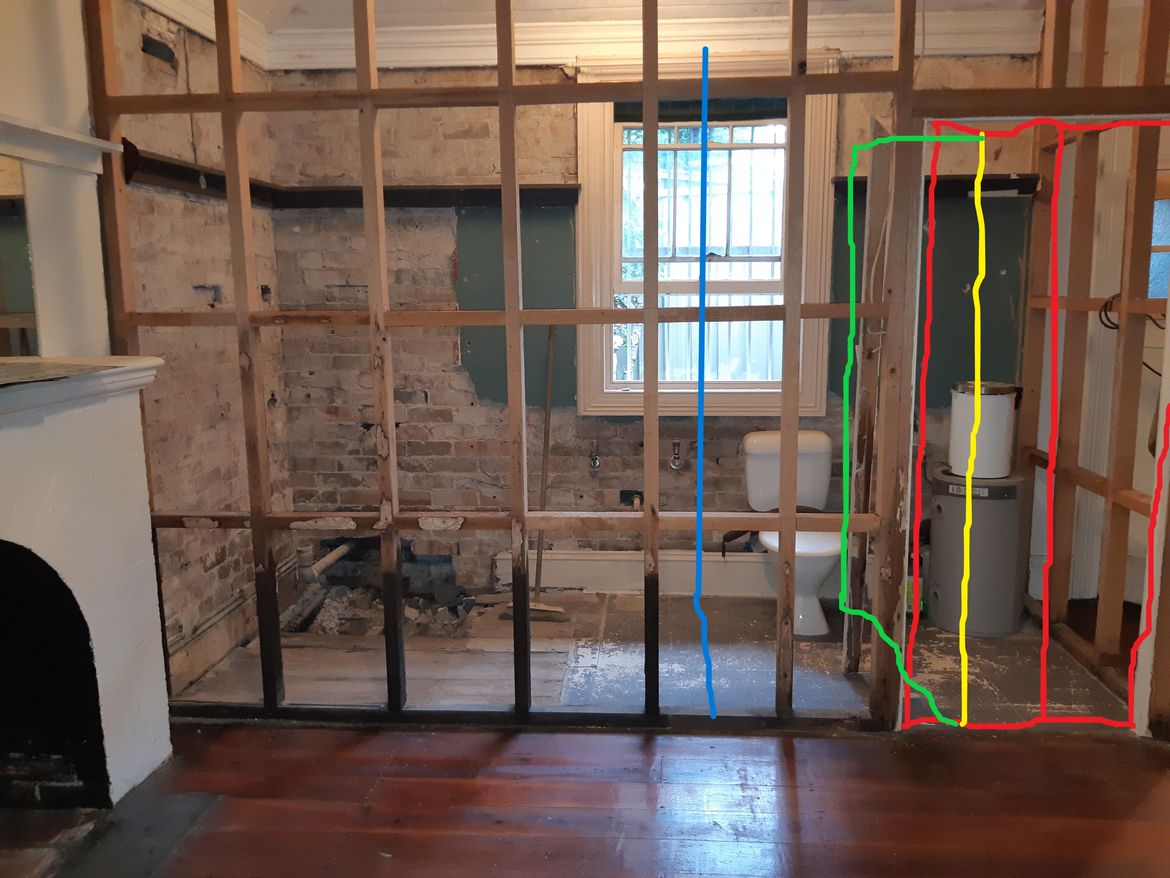
I am slowly restoring my heritage home (built aprox 1890's) I am currently trying to divide my original double hung window (no sash cord/pulley etc ever installed but slides very well). I need to divide the rooms along the blue line to allow a toilet room with small hand basin on the right (hot water service to be relocated) and a separate room on the left which won't be used for shower or as a wet room. I do not wish to interfere with the sewer plumbing for the toilet and therefore need to divide the window. After countless hours pondering what to do I have come up with a few options.
Option 1
Leave upper and lower window panes in their closed position and install window mounted exhaust fans either side in the upper window pane. I would install a timber fake mullion down the midline with foam seal against the window to allow the stud to marry up to this. I am concerned the noise this would cause on a daily basis.
Option 2
Leave the upper window in the fully closed up position and raise the lower window enough to install an opening floor vent (similar to this https://www.bunnings.com.au/accord-10-x-30cm-antique-brass-marquis-floor-register_p0810309 ) mounted in marine ply to seal the opening around the vent. This way I can open the vent to allow air flow and can close the vent to prevent airflow if cold/wet weather (this window is rarely exposed to direct rain or heavy weather) I am not familiar with these vents and if their closed position provides adequate air seal. Obviously it would be possible to attach insect screen material on the outside of this vent to avoid insects entering.
Option 3
Install an centre mullion and 2 casement windows which open into each room due to bars outside the window preventing outward opening. Whilst more ideal I can see this being a far more complex and labour intensive process
Option 4
Retrofit the window with a centre mullion and custom make double hung windows both sides with salvaged old timber windows. I am confident this would look nice however would likely be an extremely challenging and demanding process
I have considered retrofitting louvre glass windows either side however when this was quoted it is cost prohibitive (aprox $1300 supply only)
I would be doing the work myself and am confident with the timberwork and have fully restored the all the old timber double hung windows in my place. The image attached is an older image in my renos and shows the original arrangement of the window with the upper pane lowered to its resting position with insect screen material stapled in position.
I look forward to your suggestions/thoughts


- Mark as New
- Bookmark
- Subscribe
- Mute
- Subscribe to RSS Feed
- Highlight
- Report Inappropriate Content
Re: How to ensure window ventilation in bathroom renovation?
You are on the right track with the revised layout, keeping the window intact is a sensible long-term decision, and your planning around the stud junctions and lining support looks well thought through.
In an internal bathroom or toilet renovation, H2-treated pine is the standard and most appropriate choice for wall framing. H2 is designed for internal, above-ground use where there is a risk of occasional moisture exposure, which is exactly the scenario inside a bathroom, provided the space is built correctly. H3 is intended for external or exposed environments where timber may be frequently wetted, and it is not recommended for internal wall framing. In addition to being unnecessary, H3 is more prone to movement because it generally has a higher moisture content when supplied, increasing the risk of twisting or warping as it dries internally.
The key point is that framing timber in a bathroom or toilet should never be relied upon to manage moisture. Moisture control should be achieved through proper detailing, adequate ventilation, suitable linings such as Villaboard, and waterproofing where required. If those measures are in place, the framing should remain dry and stable, making H2 the correct and compliant option.
It is also worth noting that under the NCC, a room containing only a toilet is often classified as a wet area, requiring waterproofing. That said, local interpretations can vary, so it is still wise to confirm with your certifier or local council, particularly when installing sheet vinyl and fibre-cement linings. Even where waterproofing is not mandated, good ventilation and careful detailing around penetrations will go a long way toward protecting the structure.
Please let me know if you have any questions.
Mitchell


- Mark as New
- Bookmark
- Subscribe
- Mute
- Subscribe to RSS Feed
- Highlight
- Report Inappropriate Content
Re: How to ensure window ventilation in bathroom renovation?
Good Evening @Ben2065
Its always good having movement on projects 
I do have a question about the size/width of the toilet room? How wide will it be after the walls are done and plasterd/villaboard?
Dave
- Mark as New
- Bookmark
- Subscribe
- Mute
- Subscribe to RSS Feed
- Highlight
- Report Inappropriate Content
Re: How to ensure window ventilation in bathroom renovation?
Hi @Dave-1
The width will be 81cm (allowing 6mm villaboard on all walls) and the length is 1.36m - my plan is to have a 2.4M high false ceiling

- « Previous
- Next »
Why join the Bunnings Workshop community?
Workshop is a friendly place to learn, get ideas and find inspiration for your home improvement projects
You might also like







We would love to help with your project.
Join the Bunnings Workshop community today to ask questions and get advice.