
The Bunnings Workshop community can help with your home improvement projects.
- Bunnings Workshop
- >
- Discussion
- >
- Outdoor
- >
- Re: How can I prevent water leaking into...
How can I prevent water leaking into an external wood celling?
- Subscribe to RSS Feed
- Mark Topic as New
- Mark Topic as Read
- Float this Topic for Current User
- Bookmark
- Subscribe
- Mute
- Printer Friendly Page
Share


- Mark as New
- Bookmark
- Subscribe
- Mute
- Subscribe to RSS Feed
- Highlight
- Report Inappropriate Content
How can I prevent water leaking into an external wood celling?
Hello team,
I am looking for some suggestions please, we have a balcony that has an outdoor space below it, the ground floor has a wooden ceiling. There are a couple of issues with water getting into the wooden panels and the internal top plate:
1. The wind blows the rain sideways into the patio doors (this side is sea facing, which is 800m away and storms bring in heavy rain and very strong winds. The rain blows into the right side underneath the balcony (as you are facing the patio doors) and is going into the white trim underneath the ceiling. This is spreading to the internal top plate and we have recently had to redo the whole ceiling and also replace part of the top plate (30 cm) I have marked with an X. You will also see the old water stains.
2. You will see that there is a gutter junction and a downpipe. When there is flash flooding the gutter overflows and the water cascades down and spreads across the brickwork into the wooden ceiling.
We have had the down pipes cleaned, the balcony regrouted, the gutters cleaned, all the areas resealed (by a professional company) and it has been retested for leaks in the pipework and the balcony. However, we believe that the design is not good enough and really need to prevent water from coming in by putting up a structure such as an awning/hood/eave across the bottom beam of the balcony marked with a Y. It would also make sense to seal up the right side where the water is spreading across the brick work.
Does anyone have experience and any solution(s) to this type of problem, any suggestions welcomed. Thanks!


- Labels:
-
Plumbing
-
Repairing
-
Tools and Materials


- Mark as New
- Bookmark
- Subscribe
- Mute
- Subscribe to RSS Feed
- Highlight
- Report Inappropriate Content
Re: How can I prevent water leaking into an external wood celling?
Hi @KAV2025,
Welcome to the Bunnings Workshop community, it is fantastic to have you with us.
It's quite a complex issue, so I think we need to start by clarifying a few things.
When you previously had issues, were they isolated to a single spot, such as where you have marked with an x? Or were they along the whole front edge of the balcony?
Where does the water from the roof on this side of the balcony drain to? Is there a gutter that runs along the outside edge of the balcony?
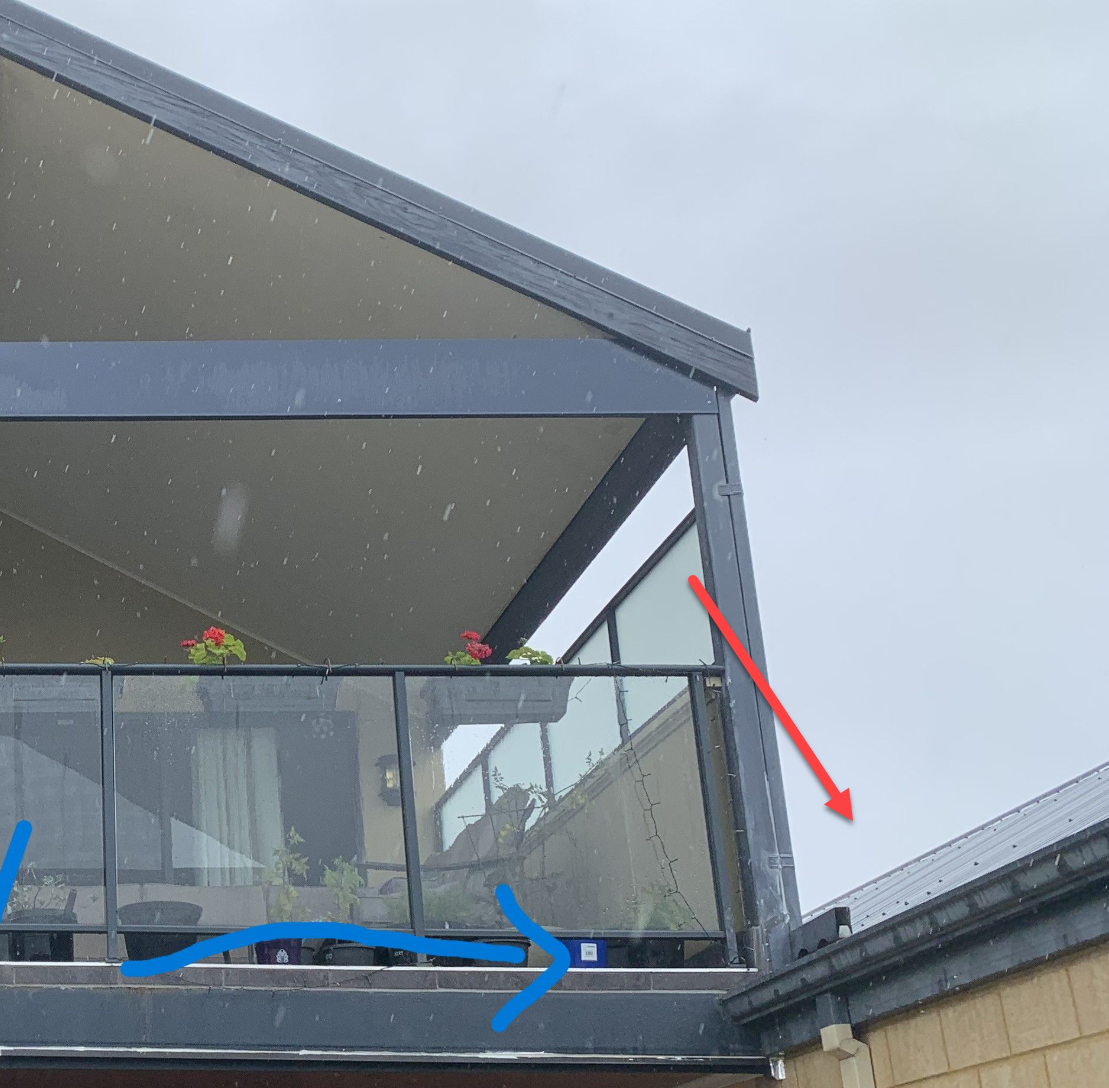
Do you think that the seam at the top edge of the beam (where you've drawn the Y) is a likely entry point for the water, based on the previous damage?
Looking at the design, I think waterproofing this front edge, particularly the seam, would be the way to go, but I'm not sure what the best way to do that would be. Maybe a custom aluminium flashing that tied into the balconies' waterproofing membrane, assuming there is one, then extended down over the beam so that any water that hits the front of the beam can not find its way to the seam above the beam.
Allow me to tag our knowledgeable members @Dave-1, @AlanM52 and @JoeAzza to see what they think.
Jacob

- Mark as New
- Bookmark
- Subscribe
- Mute
- Subscribe to RSS Feed
- Highlight
- Report Inappropriate Content
Re: How can I prevent water leaking into an external wood celling?
Good Afternoon @KAV2025
Having a think and a re-read through your questions, It looks like you have an angled small eave/metal edging along the front of the floor/ceiling? That would take care of water running down the front and curling up and onto your timber ceiling I would think. (located at the top of the downward blue arrow)
I think adding a structure across the front may change the dynamics of the area (engineering wise) so would be hesitant in adding a permanant structure. You could go with either a clear plastic alfresco/bistro styled blinds or even a screen based system to prevent bugs (but lesson the driving water) So the spray level is reduced.
When the repairs were being done did the trades have any suggestions on how to better protect the ceiling from water?
Dave

- Mark as New
- Bookmark
- Subscribe
- Mute
- Subscribe to RSS Feed
- Highlight
- Report Inappropriate Content
Re: How can I prevent water leaking into an external wood celling?
Hello @KAV2025,
Spent a while digesting your post, even went and made another cuppa.
I am thinking to initially use tarps, ropes and bungee cords to tame the ferocity of the incoming weather and then wait and see what happens.
You can then fiddle... move them around to hopefully expose one or more ingress points.
That is a low cost approach to @Dave-1's thoughts about plastic alfresco/bistro styled blinds without the $$$ outlay and not knowing the outcome.
Cheers

- Mark as New
- Bookmark
- Subscribe
- Mute
- Subscribe to RSS Feed
- Highlight
- Report Inappropriate Content
Re: How can I prevent water leaking into an external wood celling?
Hi @KAV2025 , I noticed that there is a downpipe above the guttering freezing into it, next time it rain, check if the guttering can cope with the watering pouring into the guttering, if it’s not keeping up , then it may be possible for the rain water to overflow into the eaves, possibly causing water to travel internally. If this is the cause , then you will have change the bottom downpipe to a larger size to cope with the amount of rainwater.

- Mark as New
- Bookmark
- Subscribe
- Mute
- Subscribe to RSS Feed
- Highlight
- Report Inappropriate Content
Re: How can I prevent water leaking into an external wood celling?
Thank you for your response Jacob, in answer to your questions:
1. The main point of entry for the water is point X (this appears to be the general opinion of what professionals have said, we have had over 10 different people come to look at this problem). What happens is that the water comes through at this point and is collecting in this corner, then it runs along the horizontal beam behind the metal beam and then starts pooling in the front centre of the wooden ceiling. The other end of the wooden beam on the left does not have damage. We did have one person suggest that the floor membrane may need to be replaced and this may need to happen at some point, but we are trying to fix everything else first before spending $$$ on pulling the tiles up...
2. The water that falls external to the balcony (on the right) runs through an 'invisible gutter', we have had this area checked by a roof plumber and he has said that all is ok
3. I don't think the top beam is the main entry point for water, although some may get in that way
- Mark as New
- Bookmark
- Subscribe
- Mute
- Subscribe to RSS Feed
- Highlight
- Report Inappropriate Content
Re: How can I prevent water leaking into an external wood celling?
Thank you, Dave, for taking the time to respond.
With regards to the points you raise:
1. Yes, we asked a roofer to attach the small metal edging and then run sealant across the strip (which is white) to stop any drips coming back on to the wood, which has done the job.
2. We have been thinking blinds might be the way to go to help manage the driving rain, plus we need the shade.
3. We have had the ceiling replaced via a claim with our insurers and have had numerous builders/roof plumbers/roofers/leak specialist to inspect. No-one has specifically said a way to fix the problem, unfortunately. Most have said the structure is poorly designed and given that we are so close to the sea, shouldn't have been built. The issue is that the insurers will only cover the damage, we are liable for maintenance and its been very tricky to decipher the exact problem.
- Mark as New
- Bookmark
- Subscribe
- Mute
- Subscribe to RSS Feed
- Highlight
- Report Inappropriate Content
Re: How can I prevent water leaking into an external wood celling?
Thanks so much Dave for responding. That's a good idea, given the nature of water getting everywhere I'm keen not to spend lots of money when we can't be 100% if it will resolve the issue.
- Mark as New
- Bookmark
- Subscribe
- Mute
- Subscribe to RSS Feed
- Highlight
- Report Inappropriate Content
Re: How can I prevent water leaking into an external wood celling?
Thank you Joe for responding. You raise a very good point, the gutter overflows with water and definitely can't cope with the volume on storm days. Is this something that can be done via DIY or would you recommend a plumber etc to do this type of work?
- Mark as New
- Bookmark
- Subscribe
- Mute
- Subscribe to RSS Feed
- Highlight
- Report Inappropriate Content
Re: How can I prevent water leaking into an external wood celling?


Why join the Bunnings Workshop community?
Workshop is a friendly place to learn, get ideas and find inspiration for your home improvement projects
You might also like


We would love to help with your project.
Join the Bunnings Workshop community today to ask questions and get advice.