
The Bunnings Workshop community can help with your home improvement projects.
- Bunnings Workshop
- >
- Discussion
- >
- Living and Bedroom
- >
- Re: How to build a slat bed?
How to build a slat bed?
- Subscribe to RSS Feed
- Mark Topic as New
- Mark Topic as Read
- Float this Topic for Current User
- Bookmark
- Subscribe
- Mute
- Printer Friendly Page
Share


- Mark as New
- Bookmark
- Subscribe
- Mute
- Subscribe to RSS Feed
- Highlight
- Report Inappropriate Content
How to build a slat bed?
Hi first timber buyer here. I have very limited experience, but determined to make an oversized bed frame to fit a king single mattress with additional foam insert to cater for my still growing 6'6 14 year old. I have a basic design mapped out from trusty you tube videos. But unsure what timber to choose. Hardwood will last longer but with limited building experience will this be biting off to much.
If not, what hardwood ?
Will a pine bed warp over time?
How thick should the timber be for the outter frame?
How wide & thick do the slats need to be?
I don't own a thicknesser, can the timber come ready to use?
I have so many questions on timber any points in the right direction to learn more would be appreciated
🙏
How
Solved! See most helpful response


- Mark as New
- Bookmark
- Subscribe
- Mute
- Subscribe to RSS Feed
- Highlight
- Report Inappropriate Content
Re: How to build a slat bed?
Welcome to the Bunnings Workshop community @BilliesBobs. It's terrific to have you join us, and many thanks for your question about building a bed frame.
One thing to keep in mind before you start is that constructing your own bed frame is likely to be significantly more costly than buying a pre-made one. That said, if your goal is to enjoy the process and learn some woodworking skills, it’s definitely achievable.
For the timber, pine is actually a very suitable choice and is used in the majority of standard bed frames. It’s relatively easy to work with, doesn’t require specialised tools, and will last a long time as long as the frame is designed with proper support. Pine can warp if the bed is not built with adequate cross supports, but with the right design, this shouldn’t be an issue. Hardwood could be used if you want extra durability, but it’s heavier, harder to work with, and more expensive. If you did go down the hardwood route, species like spotted gum, jarrah, or blackbutt are strong choices, but they do require good saws and tools to cut and join.
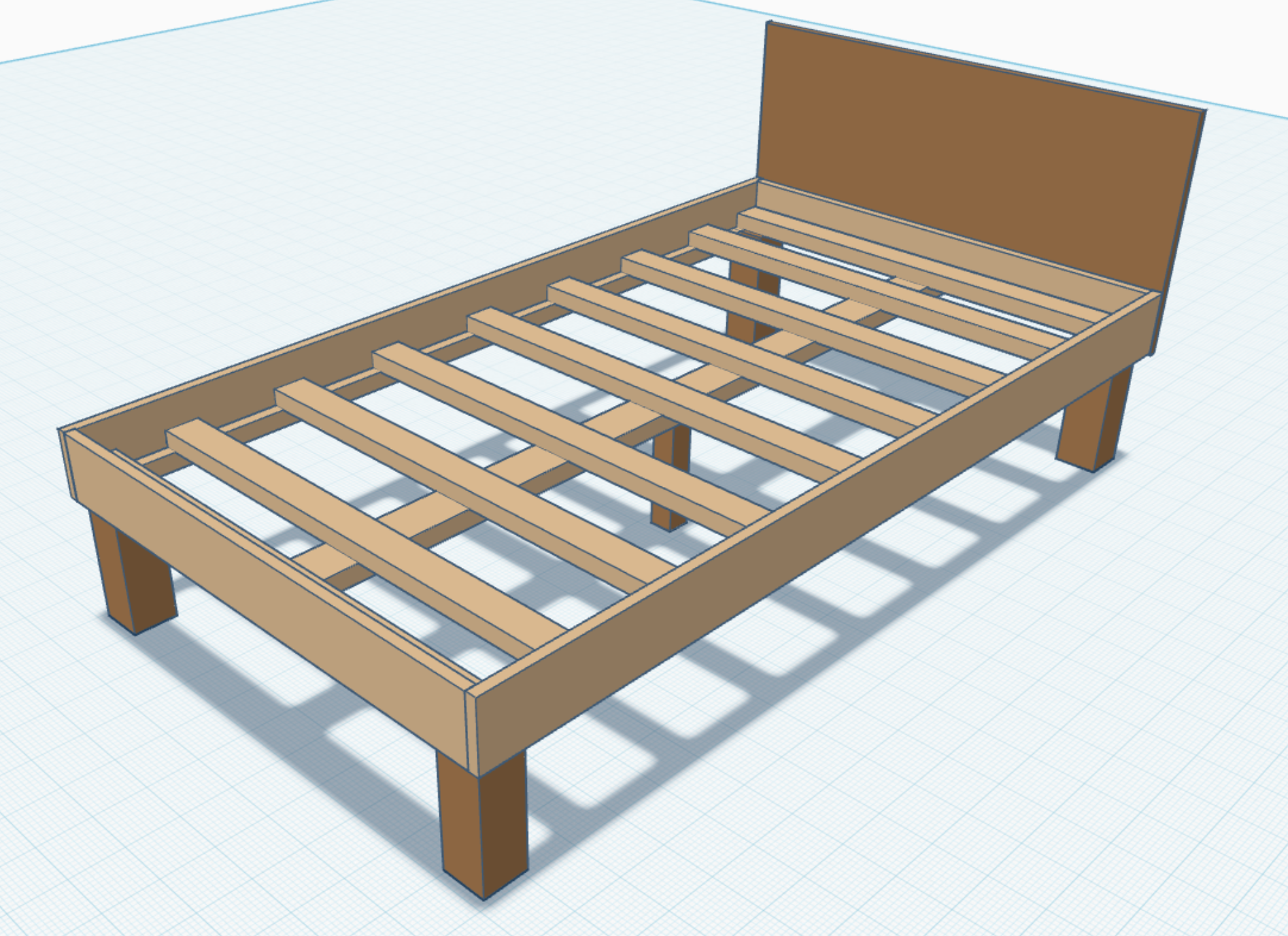
For the frame itself, 19mm-thick boards that are about 140 mm wide for the outer frame are generally sufficient to handle the weight and prevent flexing. For the slats, a common approach is 70 x 35 mm untreated timber, spaced evenly to support the mattress without sagging. You can use dressed, pre-finished timber for both the frame and slats, so there’s no need for a thicknesser or heavy sanding.
Structurally, make sure you incorporate a centre rail that's supported in the middle. You can also pre-drill all holes and use wood screws with glue for a strong join.
Overall, this is a very doable project, especially with pine and pre-finished timber. The main considerations are ensuring the slats are well supported, the frame is strong and square, and that the bed is assembled in a way that prevents any twisting or warping over time. I've created a basic design for you below to get you started.
Please let me know if you have any questions.
Mitchell


- Mark as New
- Bookmark
- Subscribe
- Mute
- Subscribe to RSS Feed
- Highlight
- Report Inappropriate Content
Re: How to build a slat bed?

- Mark as New
- Bookmark
- Subscribe
- Mute
- Subscribe to RSS Feed
- Highlight
- Report Inappropriate Content
Re: How to build a slat bed?
- Mark as New
- Bookmark
- Subscribe
- Mute
- Subscribe to RSS Feed
- Highlight
- Report Inappropriate Content
Re: How to build a slat bed?
Never knew that one existed.

Will add to my Microsoft OneNote.
Thanks
'
- Mark as New
- Bookmark
- Subscribe
- Mute
- Subscribe to RSS Feed
- Highlight
- Report Inappropriate Content
Re: How to build a slat bed?
So much useful information. Thank you kindly. 💛

Why join the Bunnings Workshop community?
Workshop is a friendly place to learn, get ideas and find inspiration for your home improvement projects
You might also like





We would love to help with your project.
Join the Bunnings Workshop community today to ask questions and get advice.